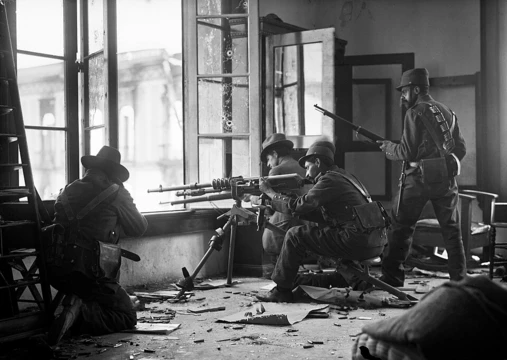
Nestor Makhno
Georgian revolutionary socialist and military commander.

Nestor Aleksandres dze Kalandarishvili (Georgian: ნესტორ ალექსანდრეს ძე კალანდარიშვილი; 8 July 1876 – 6 March 1922) was a Georgian revolutionary socialist and military commander. Born into the lesser Georgian nobility, he studied at a seminary, joined the Socialist Revolutionary Party, led an uprising during the 1905 Revolution, became an anarchist, and participated in the Gurian Republic. Exiled to Siberia, he fought an anarchist guerrilla war against the White movement in the Russian Civil War, joined the Red Army by 1919, renounced anarchism, joined the Russian Communist Party, and was killed in action fighting a White uprising.
- born
- 8 July 1876
Verified Timeline
Lore & Background
Kalandarishvili was born on 8 July [O.S. 26 June] 1876 in the Georgian village of Shemokmedi, in the Kutaisi Governorate of the Russian Empire. He came from a family of lesser Georgian nobility and had four siblings. He began school in 1884, studied at a gymnasium in Kutaisi and later a seminary in Tbilisi. From 1895 to 1897, he was conscripted into the Imperial Russian Army. After service, he returned to the seminary, where in 1900 he came into contact with members of the Socialist Revolutionary Party (PSR). He was expelled in 1903 for distributing revolutionary propaganda and joined the SR Combat Organization. He moved to Batumi, and in 1904 left the PSR to join the Georgian Socialist-Federalist Revolutionary Party. During the Revolution of 1905, he participated in a socialist-federalist uprising in Batumi. When it was crushed, he fled into hiding in Kutaisi, worked as an actor, became an anarchist, and established a Georgian Anarchist Federation. He took part in guerrilla attacks and robberies against Russian authorities and nobility, was arrested numerous times, and after the Gurian Republic was defeated, was exiled to the Russian Far East. There he continued acting and organized with exiled Georgian anarchists in Cheremkhovo. He was arrested on suspicion of plotting to assassinate the governor of Irkutsk but released for lack of evidence. Following the 1917 Revolution, Kalandarishvili organized a squadron of Caucasian anarchists to fight the Junker mutiny. In February 1918, the Central Executive Committee of Siberian Soviets appointed him commander-in-chief of their forces; he took personal command of the 1st Irkutsk Cavalry Division of Communist-Anarchists, made up of anarchists, international volunteers, and miners from Cheremkhovo. He led his division on the Eastern Front against the Baikal Cossacks commanded by Grigory Semyonov. His division was reinforced by volunteers, including Russian poet Alexander Yaroslavsky. During his guerrilla campaign against the White movement, he was given the title 'Grandpa' (Russian: Дедушка, romanized: Dedushka) owing to his long beard. In July 1918, the Siberian Soviet Republic reorganized his division into the 3rd Soviet Verkhneudinsk Division, which he retained command of and integrated into the 2nd Siberian Rifle Corps of the Red Army. In August 1918, the Baikal Front collapsed and the 3rd Division fell back to Kyakhta. In September 1918, his forces were defeated by the Baikal Cossacks. Together with a Red Guard detachment led by Dmitri Tretyakov, he led a retreat along the Dzhida river into Mongolia, taking between 800 and 1,500 soldiers. He took the detachment to Khatgal and encamped for 2 weeks on the east bank of Lake Khövsgöl, then crossed back over the border at Sanaga in Buryatia and crossed the Sayan Mountains to continue guerrilla war. In March 1919, the Siberian leadership of the Russian Communist Party (RCP) proposed an alliance. He initially rejected it but agreed after the party pledged to supply arms, funds, and soldiers. Later that year, he led guerrilla attacks against the Russian State around Irkutsk, leading Alexander Kolchak to put a bounty on him. His forces were joined by Buryat anarchist Pavel Baltakhinov, who headed its Buryat detachment. By January 1920, his guerrilla campaign culminated with the Soviet capture of Irkutsk. In 1921, he went to Moscow and met Vladimir Lenin, who convinced him to renounce anarchist communism and join the Bolshevik Communist Party. He was awarded the Order of the Red Banner and Lenin appointed him commander-in-chief of Soviet forces in the Far Eastern Republic, giving him power to appoint and dismiss officers. He turned towards authoritarianism and sought to suppress independent anarchist guerrilla groups and the White insurgency. In March 1921, the Irkutsk branch of the Korean Communist Party (KCP) gave him command of its newly-established Korean Revolutionary Military Council. On 28 June 1921, he attempted to compel the submission of Ilya Pak's Sakhalin Detachment (Korean anarchists) in the Amur Oblast. Pak refused, and between 118 and 400 people were killed in the subsequent clash, ending with the disarmament and dissolution of the Sakhalin Regiment. Vasily Blyukher blamed the violence on the Korean guerrillas. In January 1922, Kalandarishvili led 300 soldiers to Yakutia to put down a White uprising. On 6 March, he was killed in an ambush; the exact circumstances are unclear, with the official story being that he was killed by White rebels, while some historians believe he was assassinated by the Bolsheviks. His body was buried in Yakutsk on 2 April, then exhumed and reinterred in Irkutsk on 17 September.
Reader's Guide
Kalandarishvili's significance lies in his role as a Georgian revolutionary who evolved from a socialist revolutionary to an anarchist guerrilla commander, then to a Red Army leader and Bolshevik counter-insurgent. He led the 1st Irkutsk Cavalry Division of Communist-Anarchists against the Baikal Cossacks on the Eastern Front, earning the nickname 'Grandpa' for his long beard. His guerrilla campaign against the Russian State around Irkutsk culminated in the Soviet capture of the city by January 1920. After meeting Lenin in 1921, he renounced anarchism, joined the Bolsheviks, and was awarded the Order of the Red Banner. As commander-in-chief of Soviet forces in the Far Eastern Republic, he suppressed independent anarchist groups and White insurgents. He was killed in action on 6 March 1922 while fighting a White uprising in Yakutia. After the establishment of the Soviet Union, he was recognized as a revolutionary icon, with streets and collective farms named after him. Anarchist historians have contrasted him with Nestor Makhno, with Charlie Allison describing Kalandarishvili as an 'anti-Makhno'.
Did You Know?
- Kalandarishvili was given the title 'Grandpa' (Russian: Дедушка) during his guerrilla campaign because of his long beard.
- He was awarded the Order of the Red Banner after meeting Lenin and renouncing anarchism.
- Between 118 and 400 people were killed in a clash between Kalandarishvili's forces and Ilya Pak's Sakhalin Detachment of Korean anarchists on 28 June 1921.
- His body was first buried in Yakutsk on 2 April 1922, then exhumed and reinterred in Irkutsk on 17 September 1922.
- Writer Ivan Novokshonov wrote a novel titled 'The Descendant of Genghis Khan' based on a story Kalandarishvili told him about a Mongol partisan who claimed to be a direct descendant of Genghis Khan.
More in Revolutionary Leaders & Icons 1-24
Elsewhere in the Revolutionary Leaders & Icons universe
Spotted an error? Know more?
This is a living reference — every entry is fact-audited, and reader corrections feed straight into our audit queue. Suggest an edit · See this site's audit record